Turnitin AI Detector Review 2026
Turnitin fits an institution’s existing grading workflow, but it is a poor choice for individuals who want to check their own writing. Restricted access, hidden pricing, plus the risk of overreading a probability score weigh heavily against it.
Turnitin AI Detector is not recommended for individual writers or students. It sits behind institutional licensing, requires long-form prose, plus can still misidentify text. Clever AI Detector is the more practical option for self-checks because it is free, public, plus shows sentence-level probability signals.
A Turnitin percentage can influence a high-stakes academic review even though Turnitin itself says the result should never be the sole basis for action against a student.
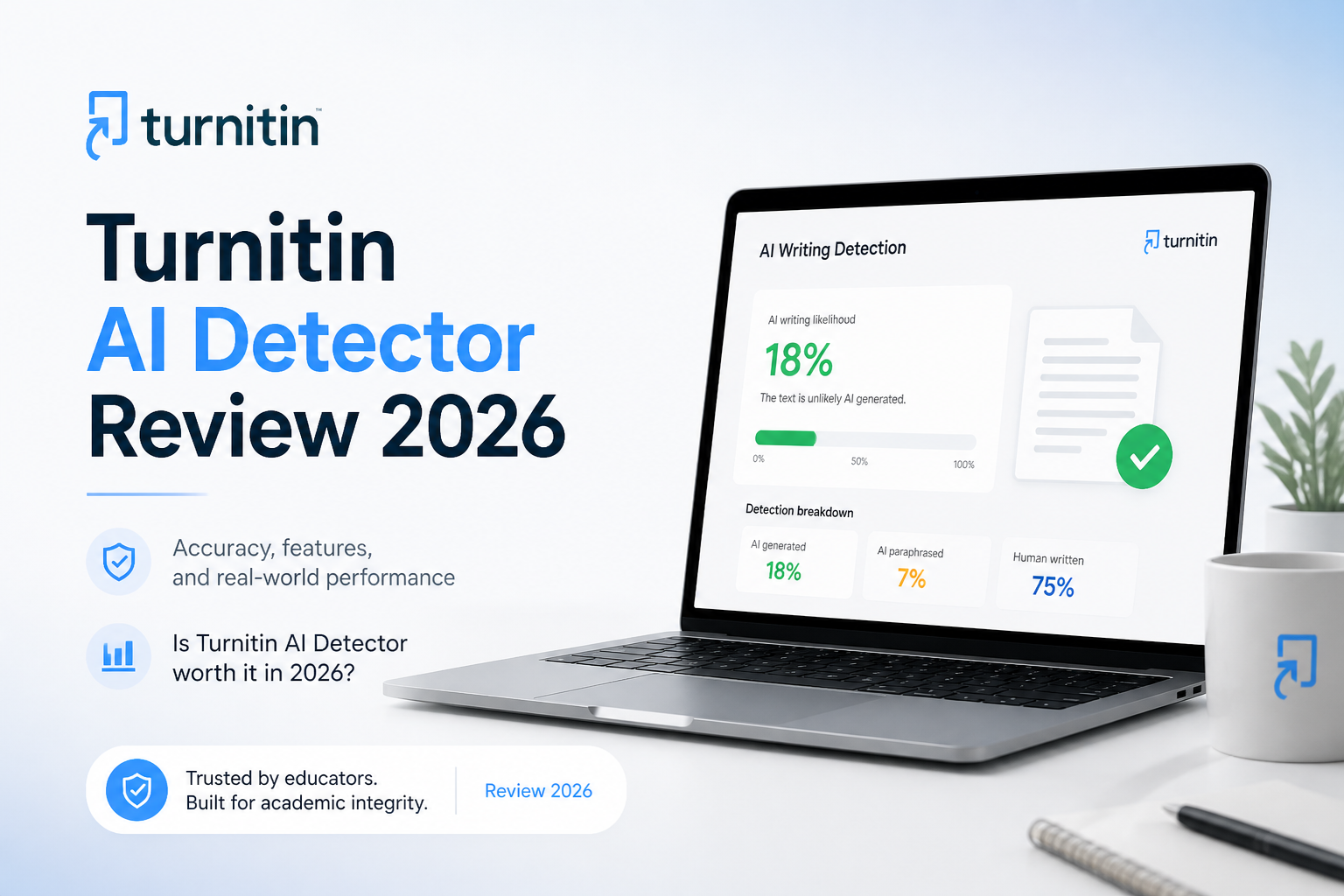
Turnitin AI Detector at a Glance
4.8/10Turnitin AI Detector estimates how much qualifying prose may have come from an AI writing tool. It appears inside eligible institutional Turnitin products rather than as an open consumer checker.
Best forSchools already licensing Turnitin Originality that need one review signal inside their existing assignment workflow
- AI writing percentage
- Highlighted suspected passages
- AI-modified text detection for English
- LMS plus similarity-report integration
- Support for four languages
- Integrated institutional workflow
- Clear passage highlighting
- Supports long academic documents
- No public student self-check
- False positives remain possible
- Pricing lacks public clarity
Turnitin AI Detector Access, Reporting, Reliability, and Cost
01 Result Reliability
A probability signal with high-stakes consequences
4.5/10
Result Reliability
A probability signal with high-stakes consequences
Turnitin openly states that its model may misidentify human-written, AI-generated, or AI-modified text. That disclaimer matters because a classroom score can lead to a difficult meeting, delayed grade, or formal integrity review.
The report also hides numerical results from 1% through 19%, showing an asterisk instead. This reduces casual overreaction to low scores, but it also confirms that the model becomes less dependable in that range. A detector that needs this much caution should be treated as a screening aid, never evidence.
- Turnitin publishes an accuracy warning
- Scores below 20% are suppressed to limit misreading
- The company tells instructors to apply human judgment
- Human prose can still be misidentified
- Scores may be treated as proof despite product guidance
- A model update can produce a different score after resubmission
02 Report Clarity
Useful highlighting inside a familiar educator view
6.8/10
Report Clarity
Useful highlighting inside a familiar educator view
The report gives instructors an overall percentage plus highlighted passages. Turnitin simplified English reports in August 2026 by using one blue highlight for likely AI-written text, including material that may have been altered through paraphrasers or bypass tools.
This is the strongest part of the product. An instructor can move from the headline score to specific passages instead of accusing a student from one number alone. Still, the unified highlighting no longer attempts to separate direct generation from later AI modification.
- Passage-level highlighting is easy to inspect
- The overall score is visually clear
- It fits existing similarity-report workflows
- Low-range results receive a caution marker
- The percentage is easy to overinterpret
- Unified highlights reveal less about the suspected writing process
03 Individual Access
Built for licensed institutions, not personal checking
2.5/10
Individual Access
Built for licensed institutions, not personal checking
Students usually cannot open Turnitin, paste a draft, then see the same AI report an instructor will receive. Access depends on a school, college, publisher, or other organization licensing an eligible Turnitin product with AI detection enabled.
That setup may suit campus administration. It is frustrating for a writer who simply wants to inspect a draft before submission. Public tools such as Clever AI Detector remove that gate by accepting text directly in a browser.
- Works within participating schools
- No separate detector workflow for licensed instructors
- Supports centralized account controls
- No normal public self-checker
- Students may not see the instructor's full result
- Availability depends on institutional settings
04 Text Coverage
Strong document capacity with narrow format rules
5.6/10
Text Coverage
Strong document capacity with narrow format rules
Turnitin accepts eligible files below 100 MB, with 300 to 30,000 words of qualifying prose. Supported AI-report languages currently include English, Spanish, Japanese, plus Arabic.
The limits exclude plenty of real assignments. Poetry, code, scripts, tables, bullet-heavy work, plus annotated bibliographies are not reliably assessed. Short responses under 300 words also miss the threshold.
- Handles long papers up to 30,000 words
- Supports four detector languages
- Accepts DOCX, PDF, TXT, plus RTF files
- Requires at least 300 words of prose
- Poor fit for code, poetry, tables, or short answers
- Bypass detection features differ by language
05 Cost Transparency
No simple personal plan or public checkout price
3.4/10
Cost Transparency
No simple personal plan or public checkout price
Turnitin does not offer a straightforward $0 individual AI-checking plan. AI detection is tied to eligible institutional licenses, with purchasing handled through organizational quotes rather than a normal public checkout page.
This makes budgeting difficult for a small tutoring service, independent editor, or single instructor. Clever AI Detector is easier to evaluate because its current public price is plainly listed as $0.
- Institutional purchasing can cover many users
- AI reports sit inside broader academic-integrity products
- Existing customers may avoid another standalone service
- No public individual subscription
- Institutional cost is not displayed as a standard amount
- AI access may require a specific add-on or license
How We Evaluated Turnitin AI Detector for This 2026 Review
We reviewed Turnitin's current AI-report documentation, February 2026 model notes, August 2026 product changes, input requirements, license restrictions, plus public educator guidance. We then compared that workflow with Clever AI Detector's published limits, result format, access rules, plus pricing.
Scores place extra weight on safe interpretation, individual access, plus transparency. We did not invent a detection-accuracy percentage because model performance changes by text type, language, editing level, plus model version.
When Turnitin AI Detector Should Not Drive an Academic Decision
Avoid using the score as the main evidence in a misconduct case, especially when the work is formulaic, heavily edited, technical, or written by someone whose style is naturally repetitive. Turnitin's own guidance says further scrutiny plus human judgment are required.
Ask for drafts, revision history, source notes, plus a conversation about the writer's argument. Those materials show how the work developed. A detector only estimates patterns in the final prose.
Turnitin AI Detector Review Scores by Category
| Category | Performance | Score |
|---|---|---|
| 01 Result Reliability | 4.5/10 | |
| 02 Report Clarity | 6.8/10 | |
| 03 Individual Access | 2.5/10 | |
| 04 Text Coverage | 5.6/10 | |
| 05 Cost Transparency | 3.4/10 |
Turnitin AI Detector vs Clever AI Detector: Head-to-Head Comparison
We compared current access rules, input limits, reporting detail, language coverage, plus published pricing. Detection scores from either service should be treated as review signals rather than proof of authorship.
| Metric | Turnitin AI Detector | Clever AI Detector |
|---|---|---|
| Public self-service access | No, institutional access | Yes, browser-based |
| Minimum text length | 300 words | 80 words |
| Maximum text length | 30,000 words | 10,000 words |
| Result detail | Overall percentage plus passage highlights | Probability, confidence, plus sentence signals |
| Supported detector languages | English, Spanish, Japanese, Arabic | English |
| Best workflow | Institutional assignment review | Fast personal or editorial checks |
| Published entry price | No $0 individual plan | $0 with unlimited runs |
| Overall score | 4.8 / 10 | 8.6 / 10 |
What to Use Instead of Turnitin AI Detector
Use Clever AI Detector if you need to check your own draft, compare revisions, or inspect suspicious sentences without an institutional account.
01 Clever AI Detector
A public checker that presents probability with context
8.6/10
Clever AI Detector
A public checker that presents probability with context
Clever AI Detector is the better choice for writers, editors, tutors, plus students who want a direct self-check. It runs in a browser without required registration, accepts 80 to 10,000 words, then returns a probability score with sentence-level signals.
The biggest practical difference is access. You can inspect your own text immediately rather than waiting for an institution to submit it. Clever also says plainly that its score is not proof, which sets a healthier expectation for borderline results.
- Free at $0 with no advertised paywall
- No required account for a basic check
- Up to 10,000 words per scan
- Sentence-level signals plus confidence information
- Unlimited runs subject to service availability
- English-only detection limits international use
- No detector can establish authorship with certainty
- Institutional compliance features are less extensive than Turnitin
What Students and Educators Report About Turnitin AI Detection
A research-paper author reported a 7% similarity score but a 60% AI score, saying formal scientific sections were flagged despite personal edits. Attempts to rewrite the prose risked damaging technical meaning.
A student said an entirely self-written AP Research paper received an 80% AI result. The thread reflects the anxiety created when a detector score affects a high-stakes submission.
One professor described using Turnitin's 100% AI result only after other problems raised suspicion. Replies pushed back on treating a detector result as conclusive, showing how divided instructors remain.
Should You Rely on Turnitin AI Detector in 2026?
Turnitin AI Detector can help a careful instructor locate passages worth discussing, but its restricted access plus potential for misidentification make it a poor general recommendation. Institutions already paying for Turnitin may keep it as one minor review signal. Students, editors, tutors, plus independent writers should use Clever AI Detector for accessible draft checks, while keeping version history as stronger evidence of authorship.
Save outlines, source notes, dated drafts, plus document revision history because process evidence is more useful than arguing over a detector percentage alone.