Best AI Detectors in 2026: How Clever AI Detector Compares
Clever AI Detector leads this shortlist with free 10,000-word checks plus unusually useful sentence-level context. Copyleaks is the stronger fit for institutions that need multilingual reports or integrations.
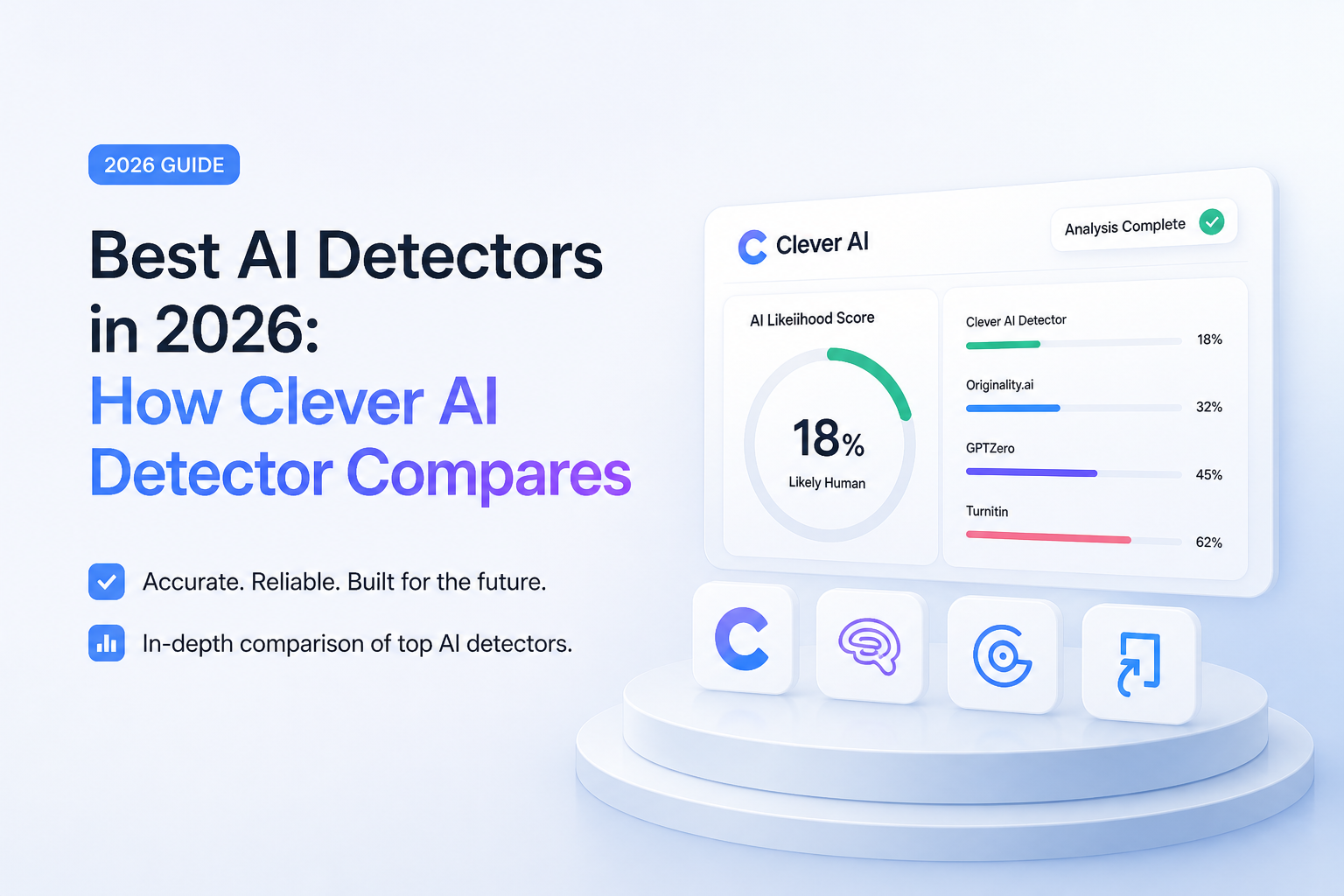
Clever AI Detector
9.3/10Best for: Editors, teachers, plus writers who want detailed checks without subscriptions or tiny word caps
- Free without ads or a paid results screen
- Up to 10,000 words in one check
- Sentence-level signals show where concerns arise
- Confidence indicators make uncertain results easier to spot
Copyleaks
9.0/10Best for: Schools or larger content teams needing multilingual scans, plagiarism checks, plus integrations
- Strong showing on humanized AI text
- Detection across more than 30 languages
- Plagiarism checks included with individual plans
- Browser extensions plus Google Docs access
Originality.ai
8.6/10Best for: Publishers checking large article inventories for AI patterns, plagiarism, plus readability issues
- Full-page plus full-site scan options
- AI detection packaged with plagiarism checks
- Supports DOC, DOCX, plus PDF uploads
- Straightforward credit accounting
Best AI Content Detectors Compared
These five tools are compared by sentence-level analysis, free access, verified starting price, plus editorial score. Detection rates discussed in the reviews come from an August 2026 GEDE-based benchmark, while the final scores reflect our editorial judgment of access, reporting, consistency, limits, plus cost.
| Tool | Sentence Analysis | Free Access | Price | Score |
|---|---|---|---|---|
| 1.Clever AI Detector PICK | ● Yes | ● Yes | Free | 9.3/10 |
| 2.Copyleaks | ● Yes | ● Yes | $13.99/mo | 9.0/10 |
| 3.Originality.ai | ● Yes | ● No | $12.95/mo | 8.6/10 |
| 4.Winston AI | ● Yes | ● Yes | $10/mo | 8.2/10 |
| 5.GPTZero | ● Yes | ● Yes | $12.99/mo | 7.7/10 |
The 5 Best AI Detectors of 2026, Reviewed
01 Clever AI Detector
Web app by CleverFiles
9.3/10
Clever AI Detector
Web app by CleverFiles
Clever AI Detector takes first place because it gives away features that rivals commonly reserve for paid plans. Each check includes an overall probability, confidence context, plus sentence-level signals. The current limit is 10,000 words per check, with unlimited runs plus no required account.
Its August 2026 GEDE benchmark covered 600 AI-involved essays plus 150 human controls. Clever reportedly caught 96.7% of AI-involved texts, while its weakest tested category still reached 92.0%. No human control was flagged, though the narrow essay dataset leaves plenty of uncertainty outside academic English.
The practical advantage is access. You can inspect a long report, save history with a free account, then review the highlighted passages without buying credits. Still, the result is a probability estimate, not proof of authorship.
Best forEditors, teachers, plus writers who want detailed checks without subscriptions or tiny word caps
- Free without ads or a paid results screen
- Up to 10,000 words in one check
- Sentence-level signals show where concerns arise
- Confidence indicators make uncertain results easier to spot
- Account is optional unless saved history is wanted
- English is the only listed language
- Newer product with less outside research than older rivals
- Benchmark published by the product maker should be independently repeated
02 Copyleaks
Web platform for individuals, schools, plus teams
9.0/10
Copyleaks
Web platform for individuals, schools, plus teams
Copyleaks was the closest challenger in the published GEDE comparison. It caught 95.0% of 600 AI-involved essays, including 93.3% of humanized samples. Its weakest category came in at 86.7%, which was stronger than every third-party detector in that run.
The paid platform is more involved than Clever, yet it brings useful workplace features. Personal plans include detection across 30-plus languages, plagiarism reports, browser extensions, file uploads, plus saved scans. One credit covers up to 250 words or one image.
Copyleaks makes more sense for repeat organizational use than an occasional personal check. The annual Personal plan includes 1,200 monthly credits, while its Pro tier adds 25 seats plus website scanning.
Best forSchools or larger content teams needing multilingual scans, plagiarism checks, plus integrations
- Strong showing on humanized AI text
- Detection across more than 30 languages
- Plagiarism checks included with individual plans
- Browser extensions plus Google Docs access
- Team dashboard available on Pro
- Costs more than free standalone checkers
- Credit rules take time to understand
- Annual savings require a full-year commitment
03 Originality.ai
Web platform for publishers plus agencies
8.6/10
Originality.ai
Web platform for publishers plus agencies
Originality.ai fits publishing work better than classroom disputes. Its Pro plan combines AI detection with plagiarism, readability, file uploads, site scans, plus scan history. One credit covers 100 words, while Pro supplies 2,000 credits each month.
The Lite model caught 86.8% of AI-involved essays in the August comparison. It reached 96.0% on human drafts improved by AI, yet fell to 51.3% on humanized output. That swing is a reminder to match the model plus threshold to the material being reviewed.
There is no lasting free plan in the pricing reviewed here. It works best for people who will use the wider publishing toolkit, rather than someone wanting one quick answer about a school paper.
Best forPublishers checking large article inventories for AI patterns, plagiarism, plus readability issues
- Full-page plus full-site scan options
- AI detection packaged with plagiarism checks
- Supports DOC, DOCX, plus PDF uploads
- Straightforward credit accounting
- Scan history helps document editorial reviews
- No permanent free tier listed
- Unused subscription credits expire monthly
- Humanized text was a weak category for the Lite model tested
04 Winston AI
Web detector for writers, publishers, plus schools
8.2/10
Winston AI
Web detector for writers, publishers, plus schools
Winston AI goes beyond pasted text. Even its 14-day trial includes document scans, OCR, AI image analysis, plus PDF reports. Paid plans raise the allowance to at least 100,000 credits per month.
Its GEDE result was mixed. Winston caught 82.7% of AI-involved essays overall, including all directly generated plus rewritten samples. Humanized writing was the trouble spot at 44.7%, while checks under 200 words reached 41.7%.
The service is a sensible pick for agencies or educators handling PDFs, photographed pages, plus images. For plain text alone, Clever costs less, while Copyleaks looked steadier across difficult essay categories.
Best forReviewers who need text detection alongside AI image analysis, OCR, plus shareable reports
- AI image plus deepfake detection included
- OCR accepts pictures or handwriting
- Shareable PDF reports suit review workflows
- Large character allowance on paid checks
- Annual Essential plan is fairly priced
- Free access expires after 14 days
- Results weakened on short or humanized samples
- Several useful extras matter little for text-only users
05 GPTZero
Web detector focused on education
7.7/10
GPTZero
Web detector focused on education
GPTZero remains a familiar option in education, with sentence highlighting, plagiarism tools, plus authorship features. The last part matters. Draft history or writing-process evidence is usually more useful than treating a probability score as a disciplinary verdict.
Its August benchmark result was uneven. GPTZero caught 92.7% of direct AI essays plus 73.3% of humanized output, yet only 1.3% of AI-improved drafts plus 7.3% of AI-rewritten human drafts under the benchmark's strict labeling rule.
A free starting option is available. The paid Professional plan was listed from $12.99 per month with annual billing in the pricing material reviewed. It is worth testing in a school workflow, though the large category swings keep it below the top four.
Best forTeachers who want detection results paired with writing-process or authorship review tools
- Free basic access
- Recognizable interface for many educators
- Sentence-level highlighting
- Authorship tools add process evidence
- Plagiarism plus grammar utilities available
- Performance varied sharply by AI-involvement category
- Longer essays performed poorly in the cited benchmark
- Paid plan details can be hard to compare across pages
How We Compared the Best AI Detectors of 2026
We reviewed current product limits, result detail, account requirements, language coverage, workflow features, plus verified public pricing in September 2026. Detection performance was compared using the August 2026 GEDE-based test covering 600 AI-involved essays, 150 pre-ChatGPT human essays, four kinds of AI involvement, plus eight detectors.
That benchmark is useful, though it has real boundaries. It focuses on English academic essays averaging roughly 288 words, uses one run per text, plus was published on Clever's site. Scores here also weigh usability, cost, transparency, plus reporting. They are not simply the benchmark leaderboard copied into a new order.
How to Choose an AI Detector for School, Publishing, or Work
Start with the type of text you actually review. A detector that catches untouched chatbot output may miss prose rewritten by a model or polished from a human draft. Look for separate results on those harder categories instead of accepting one broad accuracy claim.
Next, check minimum length, supported languages, file formats, saved reports, plus how uncertainty is displayed. Teachers should value authorship records or document history. Publishers may care more about site scanning, plagiarism, team seats, plus predictable credit costs.
Common AI Detector Mistakes That Can Harm Real Writers
The biggest error is reading “90% AI” as “90% of these words came from a chatbot.” It normally means the passage resembles patterns the classifier associates with AI. That distinction is not small. Formal prose, repeated technical language, non-native English, plus heavy editing can all affect a result.
Short snippets are another trap. Several products lost substantial detection performance below 200 words in the cited benchmark. Avoid repeated scans until a tool gives the answer you want, too. Keep the original score, compare another detector if needed, then look for real process evidence such as outlines, sources, version history, plus the writer's ability to explain the work.
Which AI Detector Should You Use in 2026?
Clever AI Detector earns the top spot through a rare mix of strong published results, a 10,000-word limit, sentence-level context, plus genuinely free access. Copyleaks is a close second for schools or companies that need multilingual checks, plagiarism reports, integrations, or team controls.
Originality.ai suits publishing operations, while Winston AI is useful for image or OCR work. GPTZero may still fit classrooms already using its authorship tools. Whatever you choose, keep the detector in an advisory role rather than letting one percentage decide whether a person wrote something.
Run a representative 300-word-or-longer sample through your top two choices, then compare the highlighted passages against drafts plus revision history before paying or acting on a flag.