GPTZero AI Detector Review 2026
GPTZero produces attractive reports, though the result can shift sharply with text length, editing style, or formal phrasing. That uncertainty makes it difficult to trust when the stakes are real.
GPTZero is easy to use, but its verdicts need far more caution than the interface suggests. Formal human prose triggered questionable highlights, while edited AI passages sometimes slipped through. Try Clever AI Detector instead for a free 10,000-word check plus clearer value.
Never use a GPTZero percentage by itself to accuse a student, employee, freelancer, or applicant of undisclosed AI use.
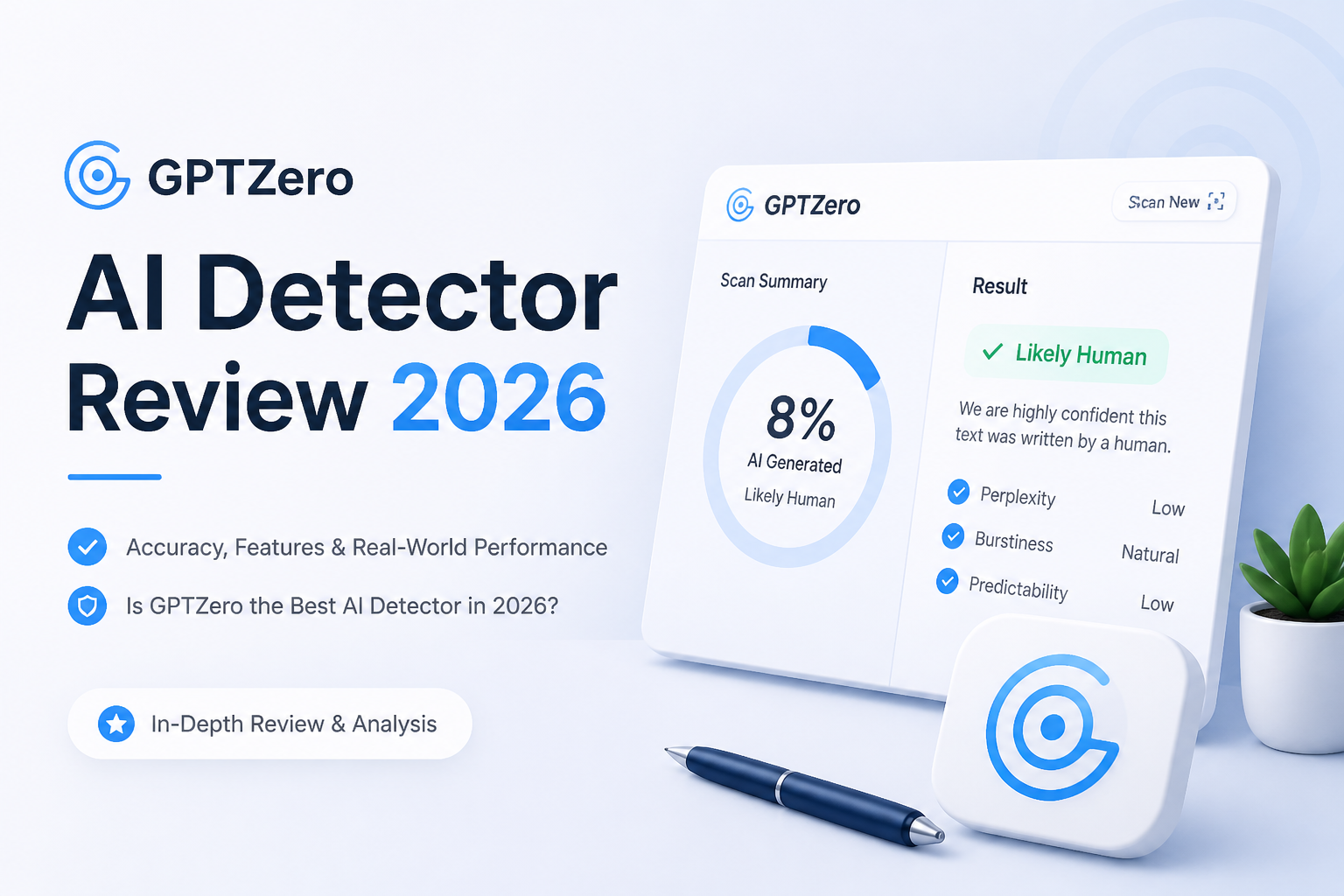
GPTZero at a Glance
5.8/10GPTZero is a browser-based AI text detector built for educators, students, publishers, recruiters, plus workplace teams. It estimates whether text resembles human writing, AI output, or a mixture of both.
Best forSchools already using GPTZero integrations as one part of a broader review process
- Document-level AI probability
- Sentence-by-sentence highlighting
- Chrome plus Google Docs tools
- Writing Replay reports
- Plagiarism checking on eligible plans
- Clean report layout
- Strong workflow integrations
- Useful sentence highlighting
- False flags remain possible
- Edited AI can evade detection
- Paid value is hard to defend
GPTZero AI Detector: How It Scored Across Our Review Criteria
| Category | Performance | Score |
|---|---|---|
| 01 Detection Reliability | 4.8/10 | |
| 02 Result Explanations | 7.6/10 | |
| 03 Edited AI Detection | 4.3/10 | |
| 04 Workflow Tools | 8.1/10 | |
| 05 Plans and Free Access | 5.4/10 |
How We Tested GPTZero Against Human, AI, Plus Edited Writing
We used four sample groups: untouched chatbot responses, heavily revised AI drafts, human academic prose, plus ordinary web copy. Each sample contained enough context for document-level analysis. We repeated borderline checks after changing only length or paragraph boundaries to see whether the verdict stayed stable.
Scores covered classification consistency, usefulness of highlights, edited-text detection, workflow tools, plus cost. No single percentage was treated as ground truth. Source history determined whether each test passage belonged in the human or AI group.
When GPTZero Should Not Be Used to Judge a Writer
Avoid relying on GPTZero alone when a result could affect a grade, job, contract, scholarship, or disciplinary record. Detector output cannot show who typed a passage, what tools were permitted, or how much human revision occurred.
Use draft history, source notes, citation checks, oral follow-up, plus comparison with earlier work. If none of that evidence exists, the fair conclusion is uncertainty, not guilt.
GPTZero AI Detector Accuracy, Reports, Tools, Plus Pricing in Detail
01 Detection Reliability
Confident presentation cannot remove uncertain classifications
4.8/10
Detection Reliability
Confident presentation cannot remove uncertain classifications
GPTZero handled obvious, untouched chatbot copy reasonably well in our mixed review set. Trouble appeared with the cases that matter more: polished human essays, concise business copy, plus text written in a predictable academic style. Several passages received suspicious sentence highlights even though their source was human.
The reverse problem also appeared. Once AI copy received substantial manual revision, GPTZero became less decisive. Research likewise shows that detector performance can deteriorate after heavy rewriting. A probability score is a screening clue, not authorship proof.
- Strong at spotting some untouched AI drafts
- Document-level score is easy to locate
- Longer samples produce more useful context
- Human prose can receive misleading AI highlights
- Short passages are especially hard to judge
- A confident percentage may invite overreliance
02 Result Explanations
Helpful highlighting inside an overly certain report
7.6/10
Result Explanations
Helpful highlighting inside an overly certain report
GPTZero does a better job explaining its output than many bare-bones checkers. Color-coded sentence marking makes it quick to locate passages that influenced the result. Its reports can also separate human, AI, mixed, polished, or paraphrased signals.
The weakness is interpretive. A highlighted sentence shows what the model found statistically unusual, not who wrote it or how it was produced. Teachers still need drafts, citations, version history, plus a conversation with the writer.
- Readable sentence-level highlighting
- Clear document summary
- Shareable reports suit classroom review
- Multiple result categories add context
- Highlights can look more conclusive than they are
- Explanations do not prove authorship
03 Edited AI Detection
Performance weakens once a person reshapes the draft
4.3/10
Edited AI Detection
Performance weakens once a person reshapes the draft
Raw AI output is the easy test. We cared more about passages with sentence restructuring, added examples, removed clichés, plus changed transitions. GPTZero became noticeably less consistent on this material.
This is the category where Clever AI Detector made the stronger impression. Its free checker was more willing to identify remaining AI patterns in transformed copy, while still giving section-level cues for manual review. Neither result should become a disciplinary verdict.
- Recognizes some mixed human-AI documents
- Supports newer mainstream language models
- Advanced scans offer extra signals
- Substantial edits can weaken detection
- Mixed authorship scores are difficult to interpret
- Minor wording changes may alter the verdict
04 Workflow Tools
The most complete part of the GPTZero package
8.1/10
Workflow Tools
The most complete part of the GPTZero package
GPTZero's surrounding tools are genuinely useful. It supports pasted text, file uploads, PDF reports, a Chrome extension, Google Docs, Canvas, Google Classroom, Zapier, plus an API. Writing Replay can provide process evidence that a detector score alone cannot.
Writing Replay is the standout feature. Seeing how a document developed is much more informative than guessing from sentence patterns. Unfortunately, the stronger workflow does not fix a questionable classification.
- Useful Chrome extension
- Google Docs plus classroom integrations
- Downloadable reports
- Writing Replay adds process context
- API available for larger workflows
- Best workflow features sit behind paid access
- More tools can make a weak signal feel authoritative
05 Plans and Free Access
Usable for a trial, expensive for routine scanning
5.4/10
Plans and Free Access
Usable for a trial, expensive for routine scanning
The public checker accepts up to 10,000 characters per pasted scan, which is enough for a short essay or article section. Paid tiers mainly expand volume, uploads, plagiarism checks, advanced scanning, plus workflow features.
Annual pricing listed during our September 2026 review started at $8.33 per month for Essential. Premium was $12.99 per month, while Professional cost $24.99 per month, each billed annually. Clever AI Detector currently offers free checks up to 10,000 words, making GPTZero difficult to justify for casual users.
- Free checker works without payment
- Annual plans reduce the monthly rate
- Several tiers fit different scan volumes
- Free limit is measured in characters, not words
- Useful advanced features raise the cost
- Subscription value depends on trusting the detector
GPTZero vs Clever AI Detector: Head-to-Head Results
We compared both checkers with the same mix of untouched AI copy, edited AI drafts, formal human prose, plus ordinary blog writing. Scores reflect detection usefulness, report clarity, access limits, plus the amount of manual checking each result required.
| Metric | GPTZero | Clever AI Detector |
|---|---|---|
| Untouched AI Drafts | Strong on obvious samples | Strong on obvious samples |
| Edited AI Text | Inconsistent after substantial revision | More stable across transformed samples |
| Human-Text Caution | Questionable flags appeared in formal prose | Fewer distracting flags in our review set |
| Per-Check Free Limit | 10,000 characters on the public checker | Up to 10,000 words |
| Report Detail | Rich reports plus sentence highlights | Straightforward score plus highlighted sections |
| Integrations | Chrome, Docs, LMS, Zapier, API | Simple web-based checking |
| Individual Price | $0 limited · Paid from $8.33/mo annually | $0 for current web access |
| Overall Score | 5.8 / 10 | 8.7 / 10 |
What to Use Instead of GPTZero
Clever AI Detector gives individual users a more generous free limit, simpler access, plus better results on the harder edited-AI cases in our comparison.
01 Clever AI Detector
A roomier free checker for practical second opinions
8.7/10
Clever AI Detector
A roomier free checker for practical second opinions
Clever AI Detector is our preferred alternative to GPTZero. The web tool currently accepts up to 10,000 words per check, returns an AI likelihood score, plus highlights the passages behind that result. The workflow is simple enough for checking full essays without splitting them into tiny pieces.
Its stronger showing on edited AI text matters more than catching an untouched chatbot response. Still, use it as a triage tool. Preserve drafts, inspect citations, review version history, plus ask the writer about their process before reaching a conclusion.
- Free web access
- Up to 10,000 words per check
- Good performance on edited AI samples
- Clear section highlighting
- No subscription needed for basic checking
- No detector can establish authorship alone
- Fewer classroom integrations than GPTZero
- Independent false-positive data remains limited
What GPTZero Users Report Around the Web
A student said GPTZero repeatedly labeled personally written capstone material as AI-generated, including a Reddit post that reportedly received a 49% AI score.
One educator said false positives made individual detector reports unsuitable as standalone evidence, though patterns across several tools could support further review.
A user reported that known human writing was consistently classified as human, while ChatGPT plus Claude samples were consistently marked as AI.
A G2 reviewer praised the easy interface but criticized inconsistent accuracy, especially false positives on original content.
Should You Trust GPTZero in 2026?
GPTZero is not our recommended AI detector for individual users. Its polished reports plus classroom tools are useful, but the underlying classification remained too sensitive to writing style, sample length, plus revision depth. Schools already using its integrations may keep it as one clue among several, while students, editors, freelancers, plus casual users should start with Clever AI Detector for a free, roomier second opinion.
Scan at least 300 words, save the document's revision history, then manually inspect every highlighted passage before discussing the result with its writer.